
Scattered
A note in one app. A task in another. An email you keep meaning to send — and you’re the one holding every thread. You find.
Ethos remembers everything you tell it, thinks with you about what it means, and acts with your yes — a companion for your days, not another workspace to maintain.
Private by default. Ethos sees only what you allow — and what you tell it is never sold or rented. Read our privacy promise →
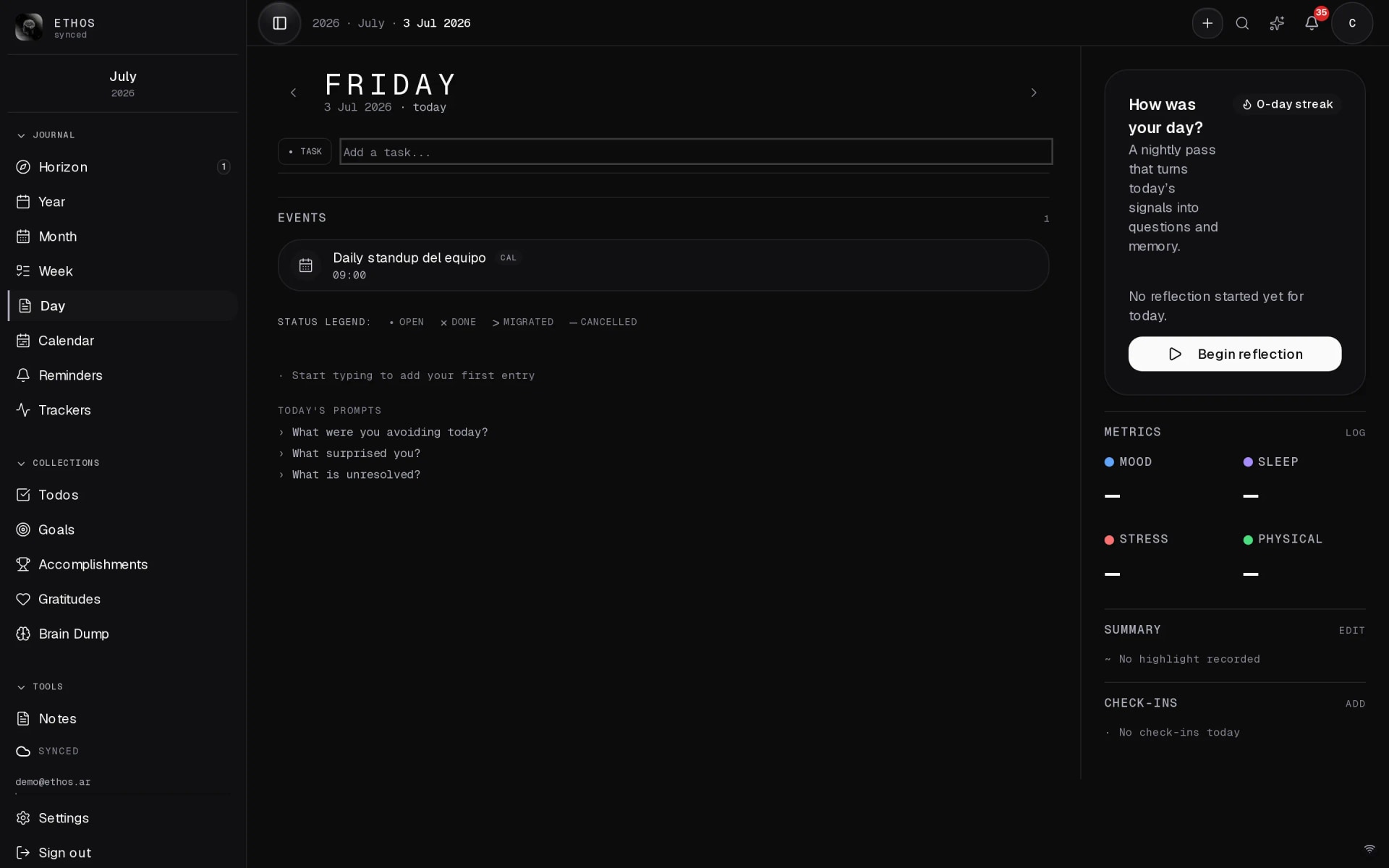
You’ve tried twelve apps. Your life is still scattered across all of them — and you’re the one holding every thread.
A note in one app. A task in another. An email you keep meaning to send — and you’re the one holding every thread. You find.
One place that reaches into all of them, so the thread finds you.
Every other tool waits to be asked. By the time you remember, the moment’s gone. You schedule.
A brief in the morning, a nudge before the slip — already in motion.
The thing you needed is buried three months back. What you don’t hold onto, you quietly stop knowing. You remember.
Everything you told it, held — and handed back the moment it matters.
Behind every answer is everything that makes up your days — what you write, your week, your files, your time, and the things you keep close. Ethos holds all of it, connects it, and thinks with you about what it’s adding up to.
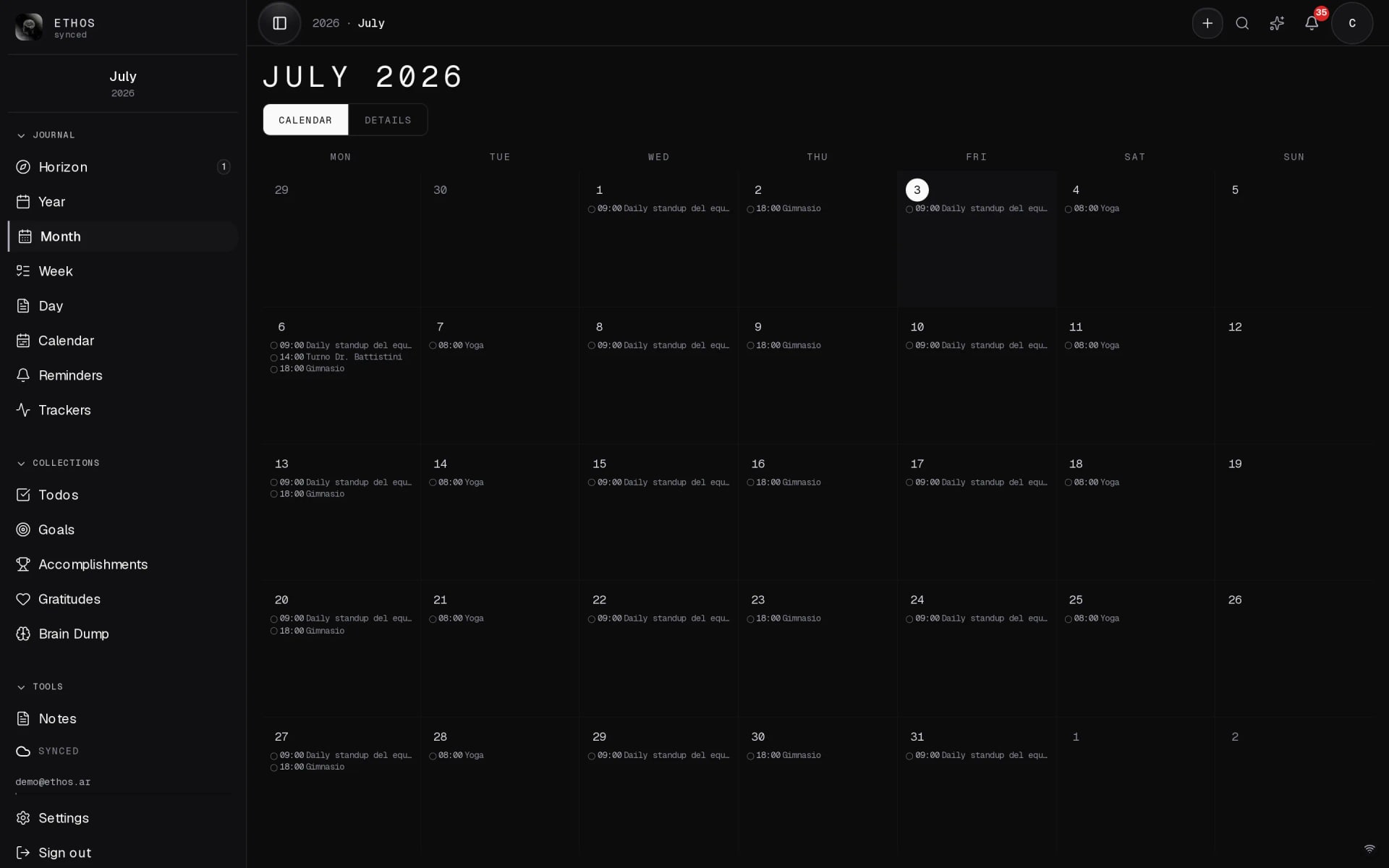
Your days in your own words — and Ethos reads them back to you, sharper.
Your weeks and your years, so nothing you promised quietly slips away.
Receipts, photos, documents — surfaced the moment you need them.
Months later, it still knows why you decided — and hands it back when it matters.
Where your hours actually go — so you can ask, and finally know.
The things you keep closest, behind a door only you open.
Ethos starts by asking who you are and how you want it to be — then keeps becoming more yours with every conversation. And what it holds in mind stays yours to open: read it, edit it, clear it, any time.
Ethos asks real questions about how you think, what you value, and how you want to be spoken to — and builds its personality from your answers.
Personality, style, ground rules, what it knows about you — every note Ethos keeps in mind sits on one page, editable by hand.
Turn on the ways of working you want, and Ethos carries them into every conversation.
You wrote about your dad three times this week — lighter each time. And Tuesday you went for a run, the first in a month. Something’s easing.
Every night, Ethos quietly connects what happened — moods, people, decisions, loose ends. Every week, it brings it back to you: what mattered, what repeated, what you might want to look at. In the good stretches and the hard ones.
Your journal doesn’t just store the month — it notices it: the theme that keeps returning, the person who keeps showing up in the good weeks.
A short reflection written for you — not a dashboard. A paragraph that reads like someone paid attention.
Ethos doesn’t only organize the bright weeks. When things are heavy, it listens, remembers gently, and keeps what you tell it safe.
You talk to Ethos the way you’d talk to your sharpest friend. It listens, it remembers — and then it goes and does the thing.
No menus, no setup, nothing to learn. Tell Ethos what you want the way you’d say it out loud — by message, or by voice note on the move.
Say it in plain words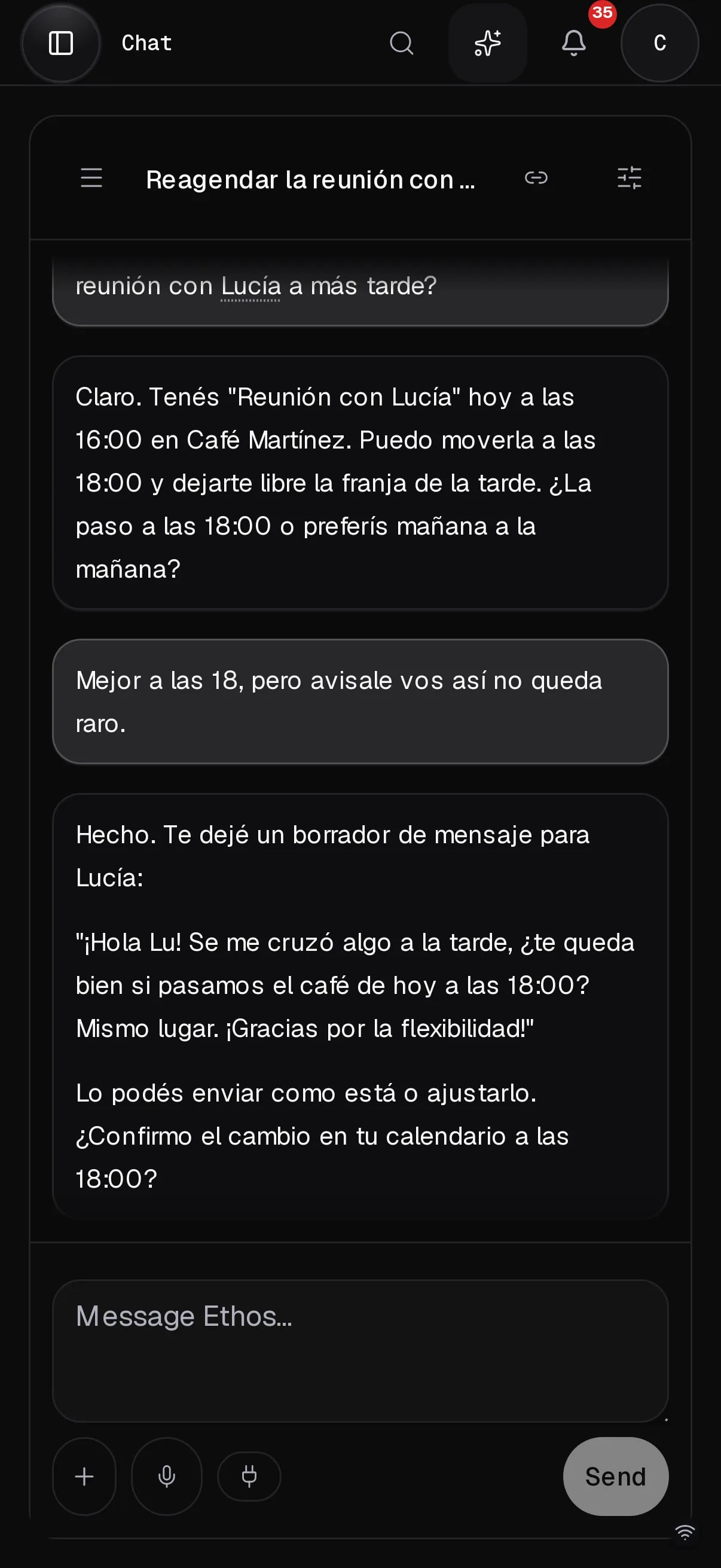
Ethos finds. Ethos schedules. Drafts the email, books the time, turns a scribble of notes into a clean document. One ask, the work done — and waiting for your yes.
Watch it do the thing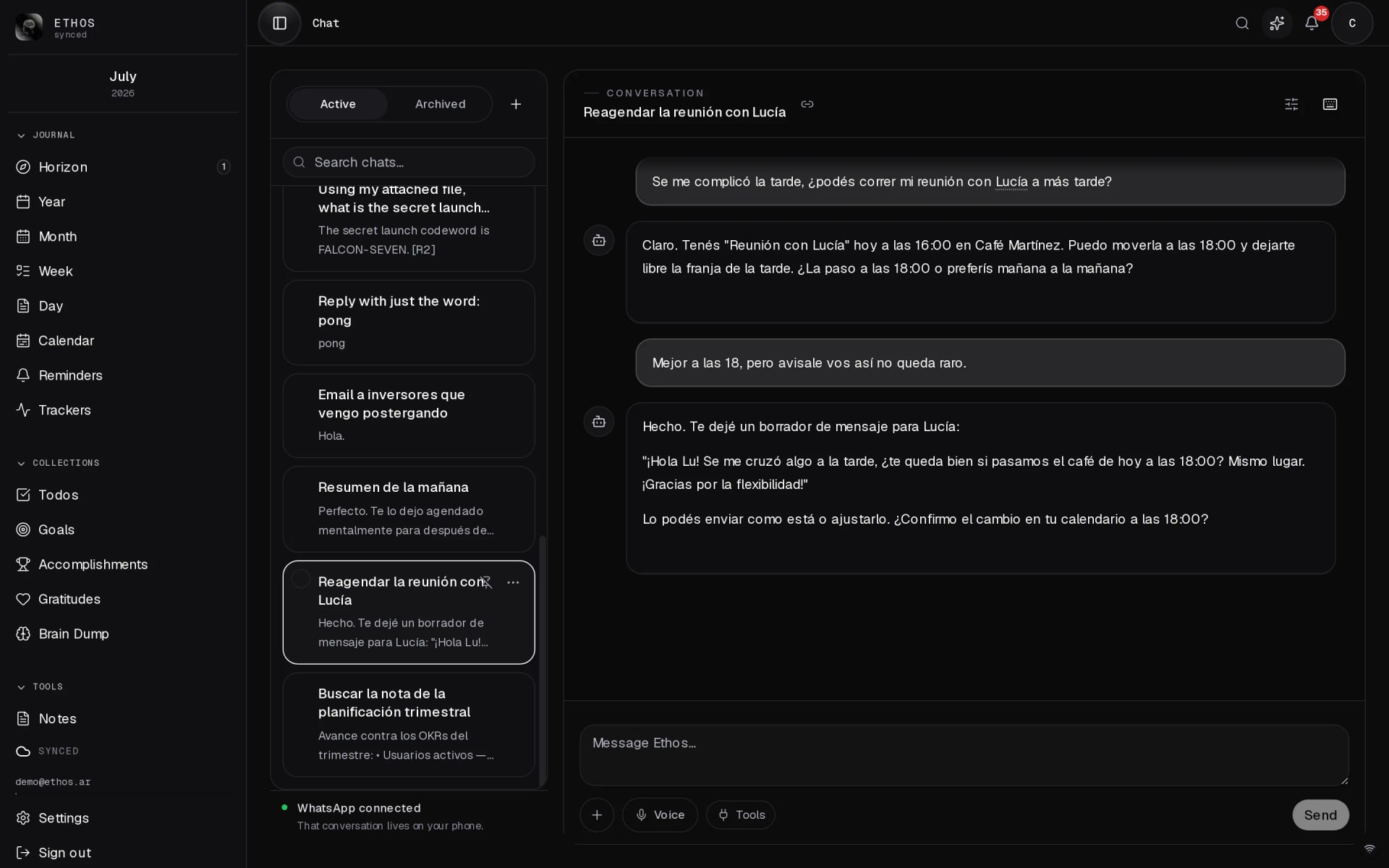
Ethos remembers. It recalls the line you wrote in March, ties the threads across your week, and hands you the pattern you’d have missed.
See what it remembers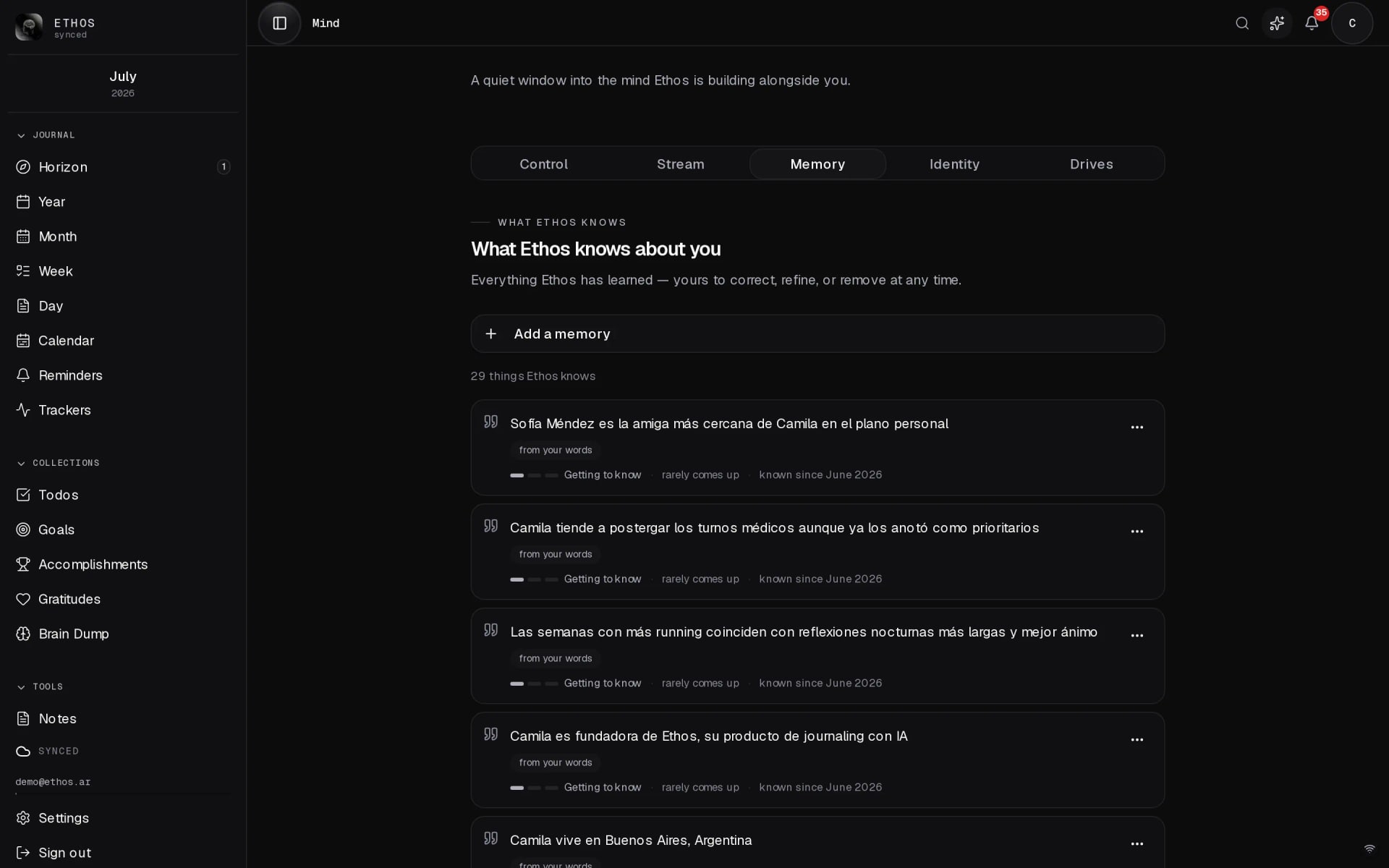
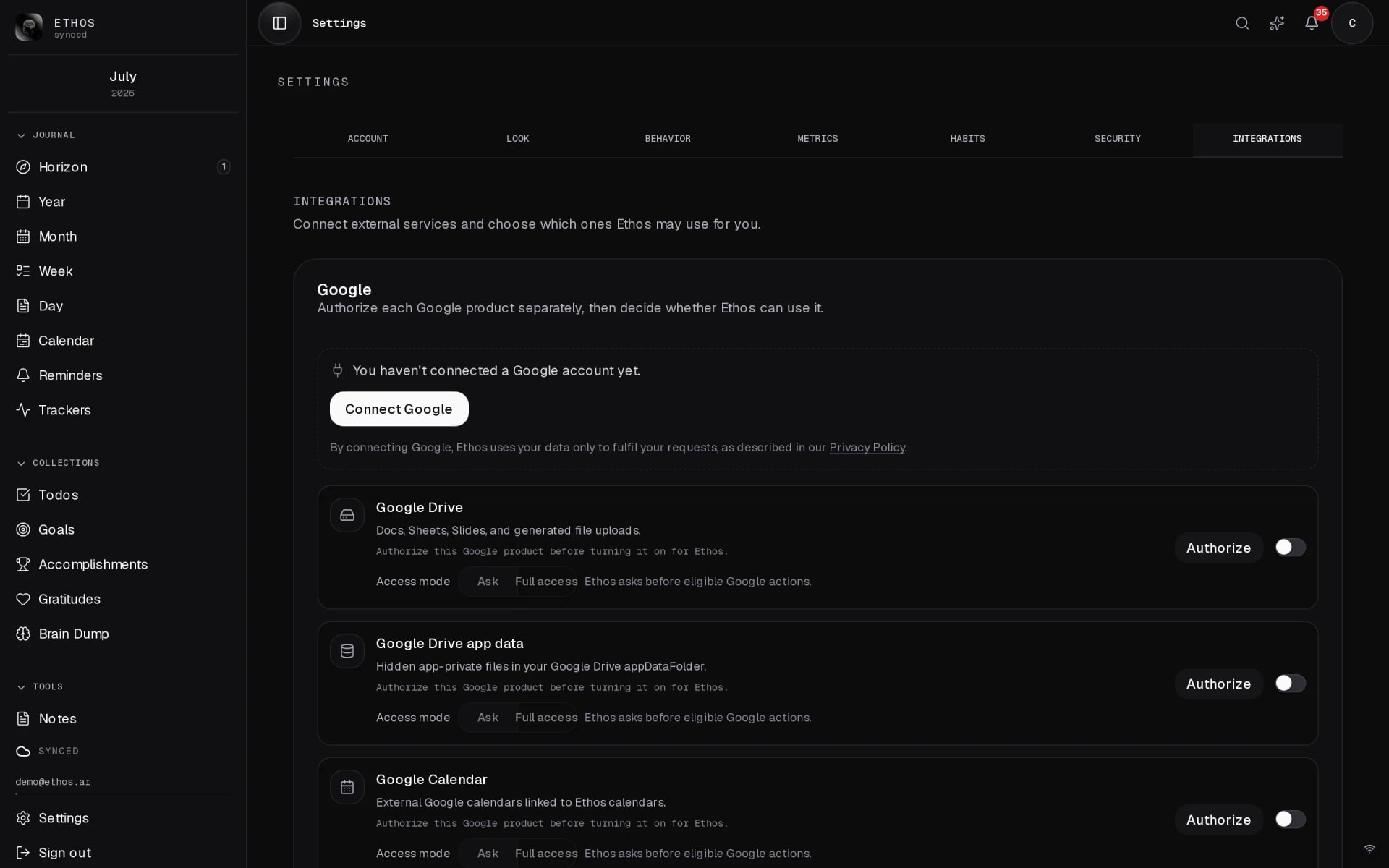
Ethos reaches into the places your life already happens. It surfaces what’s buried, drafts on your behalf, and ties it all together — and the list of connections keeps growing.
Reads your week; books and moves your time.
Drafts the email you describe; sends on your yes.
Works with the files you hand it, and the ones it creates.
Reads, writes, and tidies your documents.
Pulls the figure, fills the row.
Builds the deck, reads it back.
Ethos doesn’t wait to be summoned. A brief in the morning of what’s ahead. A quiet nudge before the thing you’d forget. A draft already waiting when you sit down. It notices the patterns, surfaces what matters, and stays a step ahead all day.
What’s ahead, what slipped, what matters — before the day starts asking.
A quiet "don’t forget" the moment it’s useful — not a wall of alerts.
The draft, the summary, the answer — waiting when you arrive.
Power without trust is a threat, not a feature. So Ethos sees only what you allow, and anything that leaves your world waits for your yes. It moves fast. You stay in charge.
Ethos drafts, suggests, and gets things ready — but sending, sharing, and anything that leaves your world waits for you. And what it does on its own, you can always undo.
Every connection is yours to switch on or off. Nothing is touched that you didn’t hand it. No surprises behind the curtain.
Your life is not a commodity. It is not advertising fuel. It is not a product we sell to someone else. The things you keep close stay closed.
“Sum up my day before I sleep”
Ethos exists because I wanted an agent I could trust with my own calendar, email, and messages — so I built it, and ran my life on it first. Everything on this page is the real product: every screenshot is Ethos as it ships, not a mockup.
One ask on WhatsApp. A meeting moved, a draft ready, a morning brief, a memory recalled — the agent, working.
A week, kept.
| when | what you said | where | what Ethos held |
|---|---|---|---|
| mon 08:12 | a voice note about the landlord meeting | meeting Thu 6pm · “bring the March checklist” | |
| mon 23:47 | a late entry you almost didn’t write | Journal | that the hard week had one good hour in it |
| tue 13:05 | “move the dentist, it clashes with pickup” | rescheduled Fri 9am · pickup left untouched | |
| wed 19:30 | nothing — you were busy | — | a nudge about Mari’s birthday. You said not yet. It waited. |
| thu 21:18 | “why am I always wrecked on Thursdays?” | Chat | the pattern: every Thursday after the standup you skip lunch |
| sat 10:02 | three photos and “keep these somewhere” | filed with the apartment notes, findable by “the tiles one” | |
| sun 20:00 | nothing said | Retro | your week, read back to you: what moved, what waited, what mattered |
The first ask is the hardest — and it’s the only hard one. From there, Ethos learns you, gets ahead of you, and helps your life make sense.
Private by default. Ethos sees only what you allow — and what you tell it is never sold or rented. Read our privacy promise →
WhatsApp · Web · Google Calendar · Gmail · Drive
